Ultimate Sensitivity
Redefines the state-of-the-art sensitivity (LOD) for important TBI and AD protein biomarkers.
Proven. Compatible. Scalable Diagnostics.
*Validated against Simoa® and ELISA with PPA/NPA ≥ 97.5% for Traumatic Brain Injury and Alzheimer's Disease under specified conditions.
What We Do
AperionDx develops innovative diagnostic solutions that make protein detection more sensitive, more reliable*, faster and effortlessly scalable.
Powered by Protein-PCR™, our solutions work on the qPCR instruments you already own, transforming existing infrastructure into a global protein-measurement network with minimal setup, no new hardware, and easy rollout across single labs or multi-site programs.
*Validated against Simoa® and ELISA with PPA/NPA ≥ 97.5% for Traumatic Brain Injury and Alzheimer's Disease under specified conditions.
Learn More
Key Differentiators
Redefines the state-of-the-art sensitivity (LOD) for important TBI and AD protein biomarkers.
Runs on widely available, generic qPCR systems; no expensive, proprietary hardware required .
Detects multiple key biomarkers in a single well via a cost-effective workflow.
Designed to complement imaging and Cerebrospinal Fluid (CSF) assays for diagnostic accuracy and research insight.
High-throughput testing for research and clinical settings with 1.5-4 hour Turnaround Time.
Our Partners
We collaborate with leading institutions to accelerate breakthroughs in diagnostics






How it Works
Protein-PCR enables ultra-sensitive detection of disease biomarkers using standard qPCR instruments already present in laboratories worldwide. This innovation enables rapid, accessible, sensitive and scalable biomarker testing, delivering results in a few hours. Each assay is designed to maximize both operational simplicity as well as exquisite analytical sensitivity and specificity for its intended target analytes.
Learn More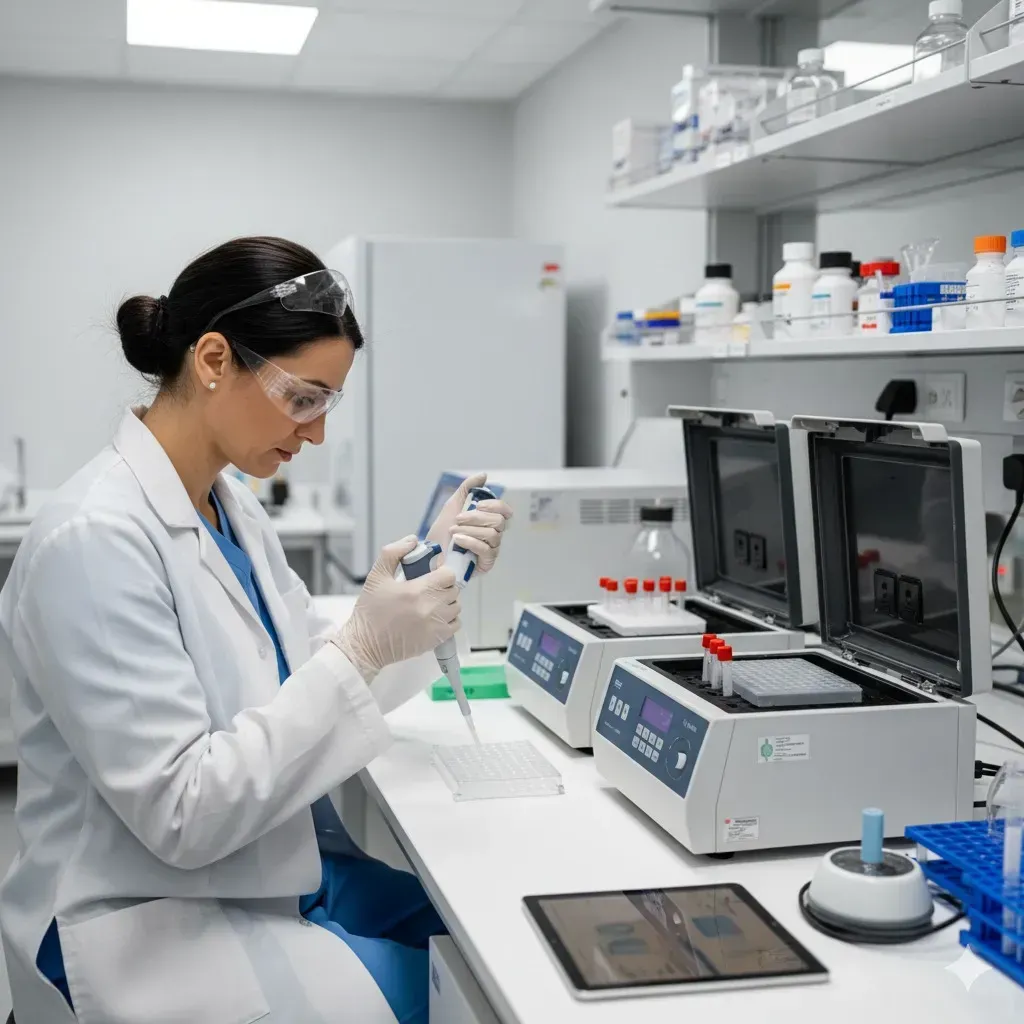
Use Cases
*Pending regulatory review.
Questions & Answers
Direct answers to what laboratories ask most often. See all questions on the Products page.
Protein-PCR enables ultra-sensitive detection of disease biomarkers using standard qPCR instruments already present in laboratories worldwide, delivering rapid, accessible, sensitive and scalable biomarker testing.
No. Protein-PCR runs on widely available generic qPCR systems, and no proprietary hardware is required. Competitive platforms use proprietary instruments costing >$70,000 to $600,000.
Protein-PCR is unrestricted in the proteins it can detect with very wide linear range assays. These include tests for infectious disease and cardiac analytes as well as those essential for detecting neurological diseases. The Alzheimer's disease panel quantifies four widely validated markers: Aβ40, Aβ42, pTau181 and pTau217. The traumatic brain injury panel quantifies GFAP, ALDOC, NGRN, BDNF and ST2.
In split sample testing with an independent, experienced laboratory, Protein-PCR performed in strong agreement with SIMOA for GFAP and BDNF, R² = 0.86 and 0.85, respectively and better than the combination of SIMOA and ELISA:
| Protein-PCR | AD | TBI |
|---|---|---|
| PPA | 100% | 97.7% |
| NPA | 97.5% | 100% |
Turnaround Time (TAT) in 1.5-4 hours for quicker, clearer next steps and deeper insights. This is significantly faster than some competitive platforms.
Use in hospitals and clinics only applies upon completion of clinical trials' data review and clearance by the FDA. Protein-PCR currently supports use in research labs, biotech companies, and pharma and drug development.
Why We're Here
We're building high-sensitivity, precision diagnostics that are affordable, scalable, and clinically rigorous, so labs can detect and monitor disease faster.
Research labs can probe with greater sensitivity. We pair Protein-PCR with the qPCR systems you already have to help your team move faster from question to answer, making high-quality testing more accessible and eventually improving patient care.